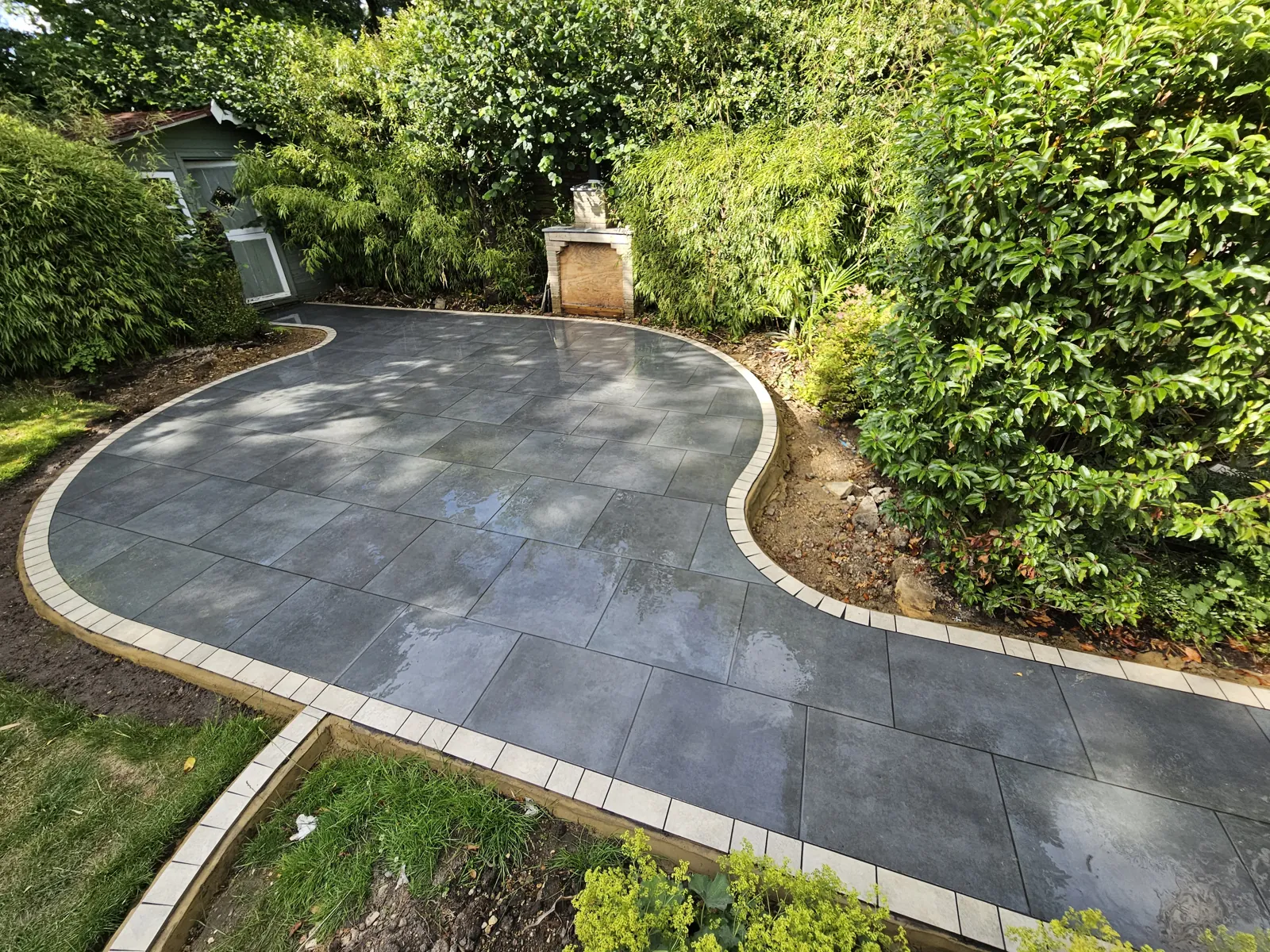
Two of the most popular paving choices we install are natural Indian sandstone and porcelain. Both look fantastic, but they behave very differently underfoot and over time. Here's an honest, side-by-side comparison to help you choose the right paving for your Hampshire garden.
At a glance
| Natural Sandstone | Porcelain | |
|---|---|---|
| Look | Warm, natural, characterful | Sleek, uniform, contemporary |
| Durability | Very good | Excellent (frost & scratch proof) |
| Maintenance | Occasional sealing & cleaning | Virtually none |
| Staining | Can stain / weather | Stain-proof |
| Typical cost /m² | ≈ £115 | ≈ £130 |
Natural sandstone: warmth and character
Indian sandstone is a natural riven stone, so every slab is subtly different in tone and texture. That variation gives a warm, timeless, characterful look that suits traditional and cottage-style gardens beautifully. It's naturally slip-resistant thanks to its textured surface, and it's a little kinder on the budget at around £115 per m² installed.
The trade-off is maintenance. Because it's porous, sandstone benefits from sealing and can weather, develop algae or pick up stains over time — nothing a periodic clean won't handle, but it does need a bit more care than porcelain.
Porcelain: sleek and low-maintenance
Porcelain is a manufactured, ultra-dense tile. It's frost-proof, scratch-resistant and virtually stain-proof, needs no sealing, and keeps its colour without fading. The consistent sizing and clean edges create a sharp, modern finish that works brilliantly with contemporary homes, slatted screening and large-format layouts. You can see examples in our portfolio, and we cover pricing in detail in our porcelain patio cost guide.
The main considerations are a slightly higher cost per m² and the need for an experienced installer — porcelain must be laid on a full mortar bed with the correct primer, or tiles can lift. This is precision work, and it's exactly what our team does day in, day out.
Want an accurate price for your project?
Use our free 60-second Instant Estimator for a ballpark, or book a no-obligation survey for a fixed quote.
Get an Instant EstimateWhich should you choose?
Choose sandstone if…
- You love a natural, warm, characterful look
- Your garden is traditional or cottage-style
- You're happy with a little seasonal maintenance
- You want to keep the budget a touch lower
Choose porcelain if…
- You want a modern, uniform, premium finish
- Low maintenance is a priority
- You want maximum durability and stain resistance
- You're pairing it with contemporary features like slatted fencing or outdoor lighting
Still not sure? Ask the experts
There's no single "best" — it comes down to the look you love and how you'll use the space. On a free survey we'll bring samples, talk through your garden and give honest advice, then a fixed quote. Spruce Brothers install both across Hampshire, Surrey and Berkshire — book your free survey to see the options in person.